Content Playbook for Startups in an AI-Driven Search World
Content Playbook for Startups in an AI-Driven Search World
Content Playbook for Startups in an AI-Driven Search World
Create awareness, build authority, and lead the conversation in your industry with this plug and play content playbook for your startup.
Create awareness, build authority, and lead the conversation in your industry with this plug and play content playbook for your startup.

Adebayo Peter
Adebayo Peter
● 6 min read
● 6 min read
● 6 min read
For any startup serious about growth, you can’t create standalone posts across different topics and then call it a day.
If your goal is to create awareness, build authority, lead the conversation, and maybe shape the trajectory of your industry, your content needs to be intentionally planned and crafted.
Here’s how to plan your content as a startup in the AI-driven search world. These conclusions are drawn from studying, analyzing, and oscillating between Anthropic and Gong content systems (and with a bit of juice from us, too, at Ranktio).
There are 3 content categories to build your content system around, categorized into three groups:
Macro content
Content for the enterprise market
General marketing content
Micro content
Product updates
Bridging content
Prediction content
Case studies
Proprietary data
Macro content:
This is a branch of content concerned only with the audiences out there. You’re only writing about what you think will rank on search and will position you to be discovered by your audiences. There are three content sub-systems for macro content;
Content for the enterprise market
While the general audience holds your business, enterprise marketing isn't a section to overlook. In my experience, in a competitive industry, it’s easier to build your business by winning the enterprise market first, before winning the general market of individual users. Most startups in your niche are focusing on the masses anyway.
Creating content for your enterprise market is simple; you just adapt how you do content to the enterprise market.
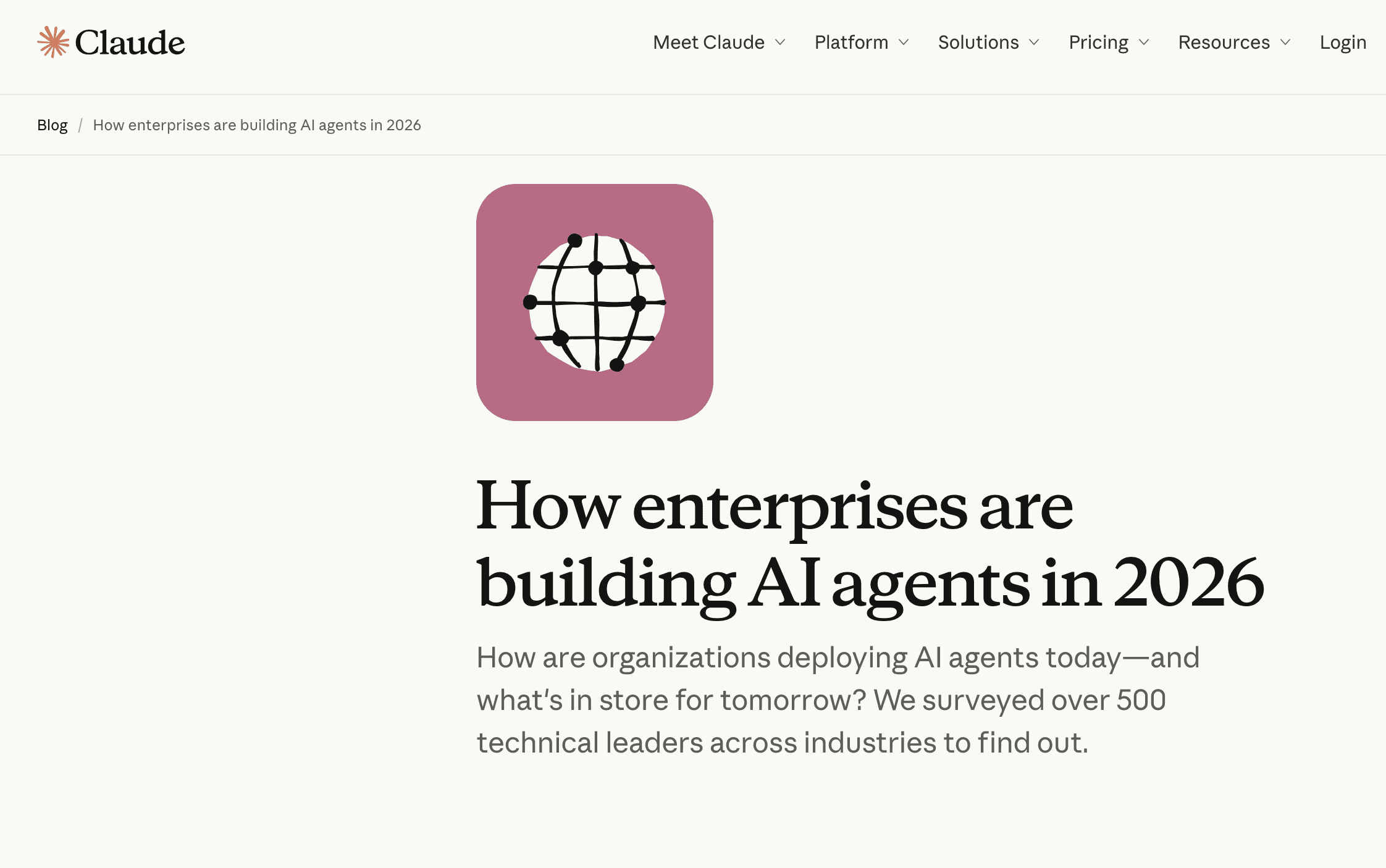
For example, if your startup helps people build AI agents, a general marketing content would be “How to build AI agents in 2026,” while content for the enterprise market would be “How enterprises are building AI agents in 2026.” Just like how the team at Claude did it.
It’s also similar to this blog post you're reading. Instead of a general “content playbook” article, I adapted it to the startups, specifically, for the ones looking for growth in the AI-driven search world.
General marketing content
General marketing content is effective, but there's a little issue I have with overly focusing on it alone. Let me ask you a question: can you think of a topic in your industry that another startup hasn’t written about before?
Probably not.
To strive in the general content category, you have to be more strategic and different from everyone else.
Here are three ways to be unique when writing about general marketing content for your startup.
#1 Write the same thing (like everyone else, but make it better):
There are many industry frameworks for this. Brian Dean called it the Skycraper Technique.
You only need to add more juice from your end. An example is from Gong - writing about sales but with added juice. Like how the content team at Gong did it.
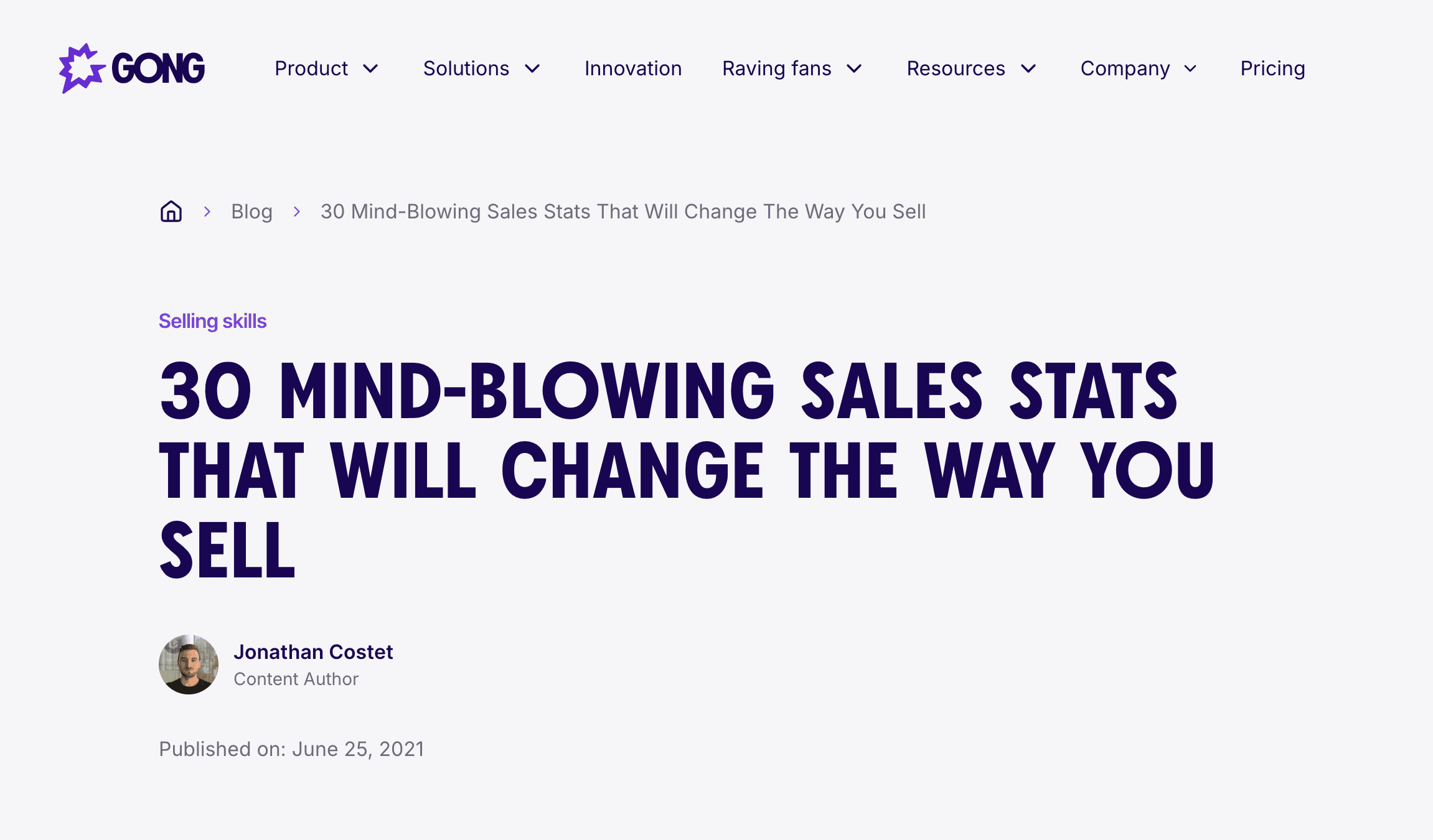
The general conventional way of writing about sales stats is writing about the general stats and numbers. Gong flipped the script by adding unconventional layers of sales statistics, like don't use ROI, it's okay to curse, etc.
There are many sales stats out there, but the majority of them are regurgitating the same stats. Gong went a little deeper with these unconventional, but true stats.
#2 Write something new:
If you're adept in the AI world like me, I'm sure you'd have come across the phrase “AI slop.”
Yeah, people thirst for something new and human, especially for the startups that use AI in their workflow or incorporate AI into their product.
It might cliche but you should minimize how inauthentic your content is. If you want to control the narrative, shape the industry, and earn greater trust, creating fresh content for your audience is crucial.
#3 Write about it, but with a unique, consistent angle:
This is what we’ve adopted at Rancoktio.
The things we write are always backed up with real-life examples from the top startups. We see what is working, find out why, then build on it, make it better, experiment with it, and then write about it.
For this post alone, we have scoured the entire internet. Kinda overstated, but we’ve checked 300+ pages, 350k+ words from 15 different top startups. All these are to find examples for each point mentioned in this post, and we do something like this on every published post.
Our unique angle is to invest in creating great content that communicates real-world, actionable strategies people can instantly get a kick out of.
In short, we're creating content backed up with more data points, surveys, ideas, and real-life examples - while being unique and consistent with it.
We are not saying you have to go that hard as ours (although we certainly won't rule that out), but tweaking certain elements from your content could be the magic button.
Micro content
This is a branch of content concerned only with your product message. You’re only writing about your product, mostly for your existing customers. There is only one content sub-system for micro content.
Product updates
This is important across all verticals, but if your startup is B2B, this is more important. It is a content system where you share your product, what it is about, how you’re building it, the team, and anything particular in your philosophy.
There are many frameworks for sharing product updates, but a few that work best highlight your tool’s prowess, new features, partnerships, and how your product works. Here's an example from FOMO Pay.

Bridging content
Bridging content creates a perfect blend between macro content and micro content systems. It entails communicating the content resources you have internally to the market out there. There are two sub-systems under this.
Predictions
Predictions let you talk about your industry. By writing prediction content, you’re owning a part of your industry’s conversation.
The major misconception about prediction is that it’s narrowed to only predicting and projecting “what will happen in [year].” Prediction is more than that.
An example is what I named "cause and effect prediction content."
It simply says if you do [this] in this [industry], you will get [that].
It goes like this: you test out the hypothesis, find the underlying details, and write about it. A canonical example is when the Ahrefs marketing team spent $15k on podcast advertising only to find 339 pageviews and 11 signups.
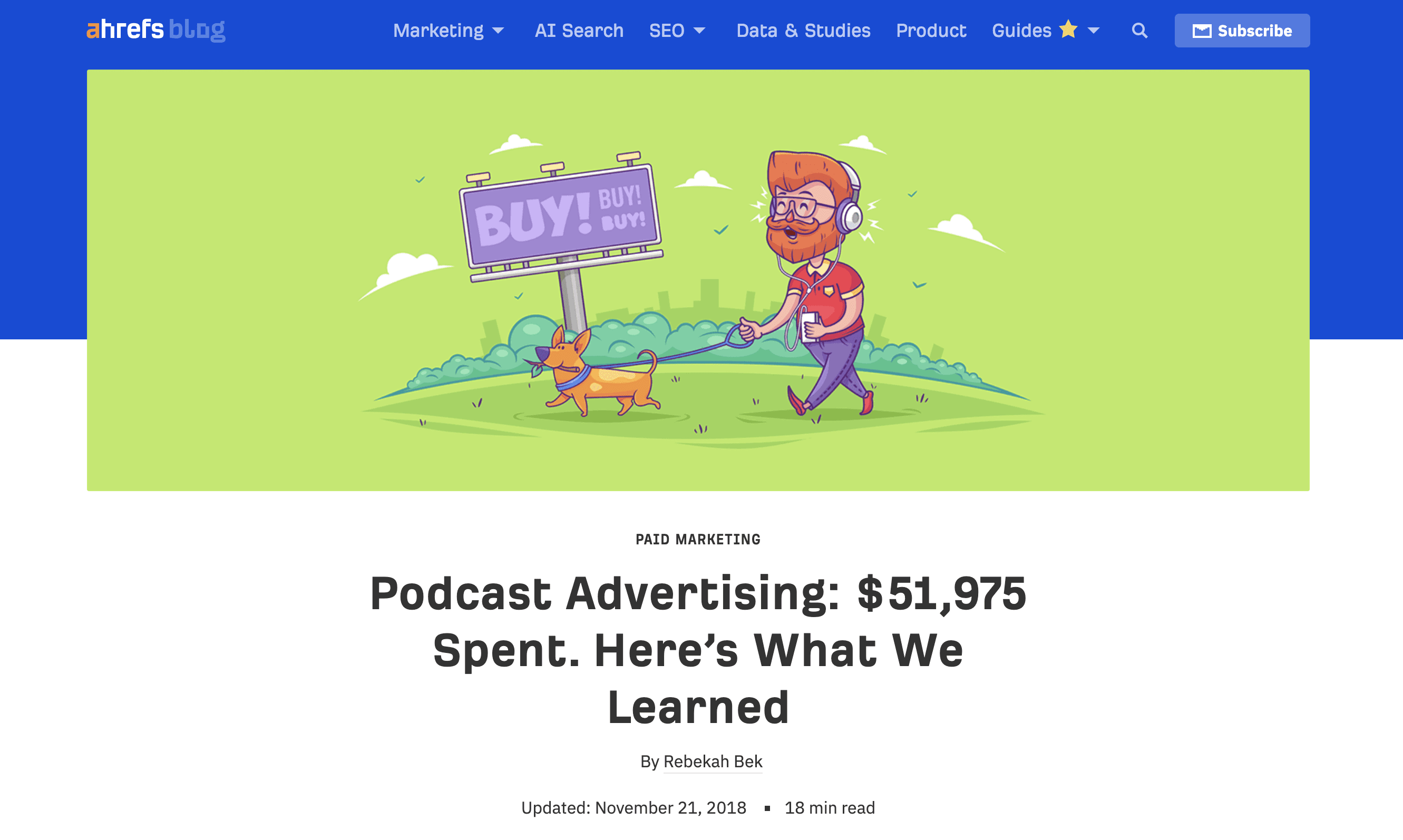
While that won’t be an industry standard of what everyone’s experience is, it still gives insights on what to expect (for SEOs, Ahrefs industry) if you want to invest in podcast advertising.
In the same way, you can make your advertising spend on Google, Product Hunt launch, other forms of advertising, or any other experiment you have done before. That becomes the industry benchmark to know what will probably happen if they do the same thing.
And like that, you become the industry reference.
Predictions are a great start to making your voice heard in your industry.
Case studies
When you think of case studies, what comes to mind?
To talk about how you helped a client?
Or to tell people how you work?
If your answer is any of these two options, you are not utilizing your case studies well. Case studies are effective at using content to connect the work you’re doing internally to the market.
There’s nothing dramatic about it. If anyone is checking your case studies, they are likely looking to work with you. And since there are plenty of people out there with different problems your product solves, you shouldn’t narrow your case studies to one specific way you helped a client.
#1 Create categorical case studies:
For example, if you’re FOMO Pay, a Singapore FinTech company that has served clients like Ferrari, F1 Auto Cars, and other big brands, a normal case study will only focus on each client and what was achieved with the partnership.
While this is the industry standard, it's still lacking strategically.
If you have served at least 2 clients in the same industry, you can create a case study aimed at the general industry rather than specific, individual case studies. A categorical case study in this sense, for FOMO Pay, would be, “How leading automobiles are using local financial services to penetrate new markets.”
While your competitors are creating individual case studies that no one will check, you're branding your case studies for a whole industry, and expanding the reach of your previous works.
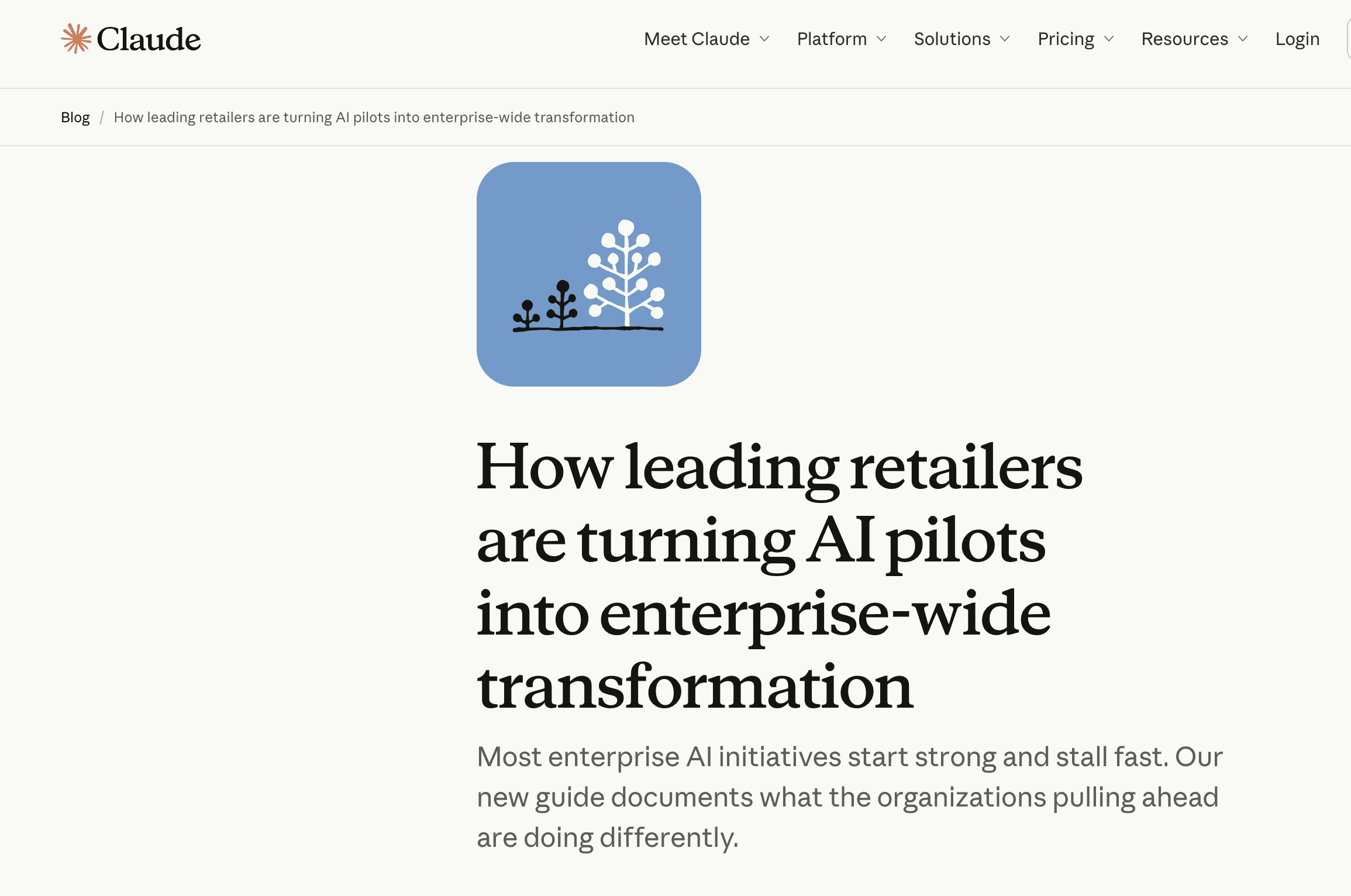
The Claude team, after serving clients like Shopify and L’Oréal, created something similar for their AI copilot adoption in the retail industry.
#2 Internalize your case studies:
Use your thing yourself, then talk about it. You have the most unique ideas about how your startup will help people, and you are probably already using it.
Anthropic uses this to further enhance their expansion of Claude Code into the non-technical verticals like marketing, using their own internal marketing team as a case study.
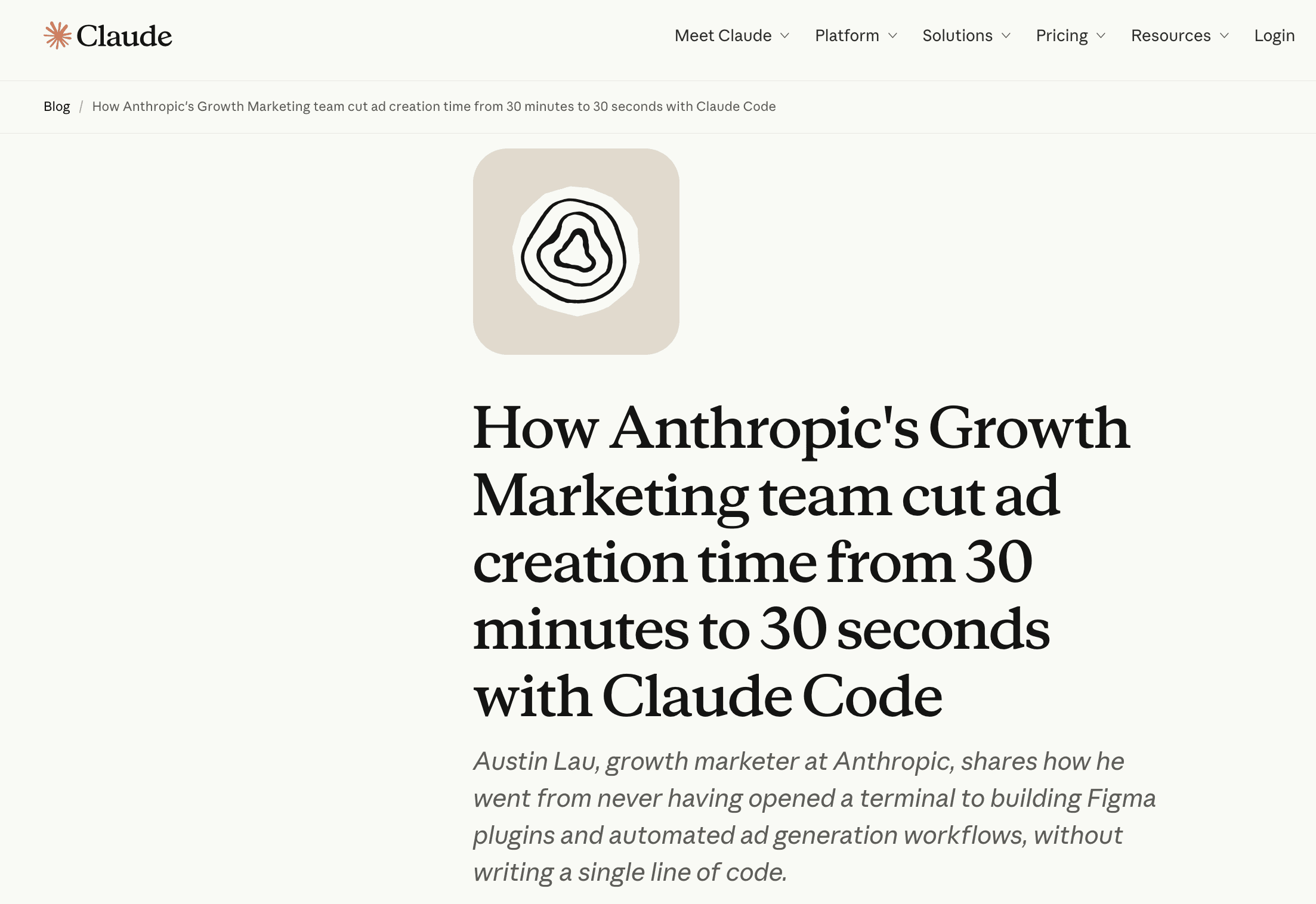
You can use this if you sell to a particular niche, but you don’t have a proven client success story yet.
Proprietary data
The last part of the content system is your proprietary data - turning your in-house data into content that gets quoted and sets the trend for your industry.
An example is from Gong.
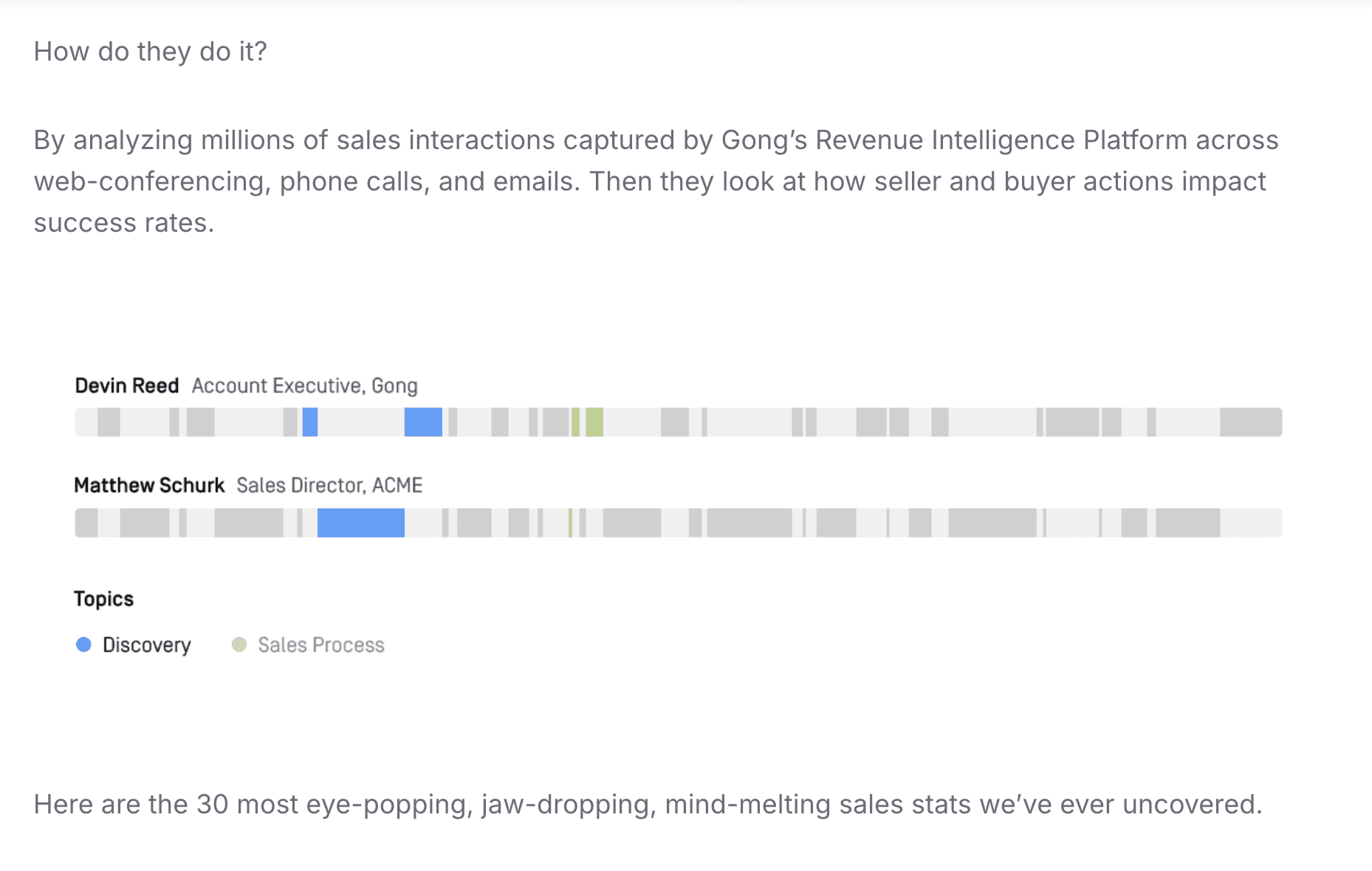
The team analysed millions of sales interactions from their Revenue Intelligence Platform to make an industry data page. This is more common than you know. There is a lot of proprietary data you can look at. For example, if you operate in a complex, specialized industry where your audience has to book a demo before using your product, that alone gives you proprietary data that a lot of content can be built on.
You can create sales stats specifically for your industry. Something like, “30 Mind-Blowing Stats To Book More Demo For Your [Industry] Software” and then use the findings from your interactions to create something meaningful.
You can then make outreach to targeted contacts in your industry to promote the blog and perhaps get you cited by bigger websites.
Getting ahead with content in the AI-driven search world
We are getting into unprecedented AI adoption across every phase of the search interactions. The old playbook of creating standalone content about anything on everything is gone.
This time, you need to plan, ideate, and tastefully create content that not only appeals to your audiences but also positions you to be discovered in the AI searches.
I hope you have found something worthwhile in this guide to up your startup visibility in this AI world.
For any startup serious about growth, you can’t create standalone posts across different topics and then call it a day.
If your goal is to create awareness, build authority, lead the conversation, and maybe shape the trajectory of your industry, your content needs to be intentionally planned and crafted.
Here’s how to plan your content as a startup in the AI-driven search world. These conclusions are drawn from studying, analyzing, and oscillating between Anthropic and Gong content systems (and with a bit of juice from us, too, at Ranktio).
There are 3 content categories to build your content system around, categorized into three groups:
Macro content
Content for the enterprise market
General marketing content
Micro content
Product updates
Bridging content
Prediction content
Case studies
Proprietary data
Macro content:
This is a branch of content concerned only with the audiences out there. You’re only writing about what you think will rank on search and will position you to be discovered by your audiences. There are three content sub-systems for macro content;
Content for the enterprise market
While the general audience holds your business, enterprise marketing isn't a section to overlook. In my experience, in a competitive industry, it’s easier to build your business by winning the enterprise market first, before winning the general market of individual users. Most startups in your niche are focusing on the masses anyway.
Creating content for your enterprise market is simple; you just adapt how you do content to the enterprise market.
For example, if your startup helps people build AI agents, a general marketing content would be “How to build AI agents in 2026,” while content for the enterprise market would be “How enterprises are building AI agents in 2026.” Just like how the team at Claude did it.
It’s also similar to this blog post you're reading. Instead of a general “content playbook” article, I adapted it to the startups, specifically, for the ones looking for growth in the AI-driven search world.
General marketing content
General marketing content is effective, but there's a little issue I have with overly focusing on it alone. Let me ask you a question: can you think of a topic in your industry that another startup hasn’t written about before?
Probably not.
To strive in the general content category, you have to be more strategic and different from everyone else.
Here are three ways to be unique when writing about general marketing content for your startup.
#1 Write the same thing (like everyone else, but make it better):
There are many industry frameworks for this. Brian Dean called it the Skycraper Technique.
You only need to add more juice from your end. An example is from Gong - writing about sales but with added juice. Like how the content team at Gong did it.
The general conventional way of writing about sales stats is writing about the general stats and numbers. Gong flipped the script by adding unconventional layers of sales statistics, like don't use ROI, it's okay to curse, etc.
There are many sales stats out there, but the majority of them are regurgitating the same stats. Gong went a little deeper with these unconventional, but true stats.
#2 Write something new:
If you're adept in the AI world like me, I'm sure you'd have come across the phrase “AI slop.”
Yeah, people thirst for something new and human, especially for the startups that use AI in their workflow or incorporate AI into their product.
It might cliche but you should minimize how inauthentic your content is. If you want to control the narrative, shape the industry, and earn greater trust, creating fresh content for your audience is crucial.
#3 Write about it, but with a unique, consistent angle:
This is what we’ve adopted at Rancoktio.
The things we write are always backed up with real-life examples from the top startups. We see what is working, find out why, then build on it, make it better, experiment with it, and then write about it.
For this post alone, we have scoured the entire internet. Kinda overstated, but we’ve checked 300+ pages, 350k+ words from 15 different top startups. All these are to find examples for each point mentioned in this post, and we do something like this on every published post.
Our unique angle is to invest in creating great content that communicates real-world, actionable strategies people can instantly get a kick out of.
In short, we're creating content backed up with more data points, surveys, ideas, and real-life examples - while being unique and consistent with it.
We are not saying you have to go that hard as ours (although we certainly won't rule that out), but tweaking certain elements from your content could be the magic button.
Micro content
This is a branch of content concerned only with your product message. You’re only writing about your product, mostly for your existing customers. There is only one content sub-system for micro content.
Product updates
This is important across all verticals, but if your startup is B2B, this is more important. It is a content system where you share your product, what it is about, how you’re building it, the team, and anything particular in your philosophy.
There are many frameworks for sharing product updates, but a few that work best highlight your tool’s prowess, new features, partnerships, and how your product works. Here's an example from FOMO Pay.
Bridging content
Bridging content creates a perfect blend between macro content and micro content systems. It entails communicating the content resources you have internally to the market out there. There are two sub-systems under this.
Predictions
Predictions let you talk about your industry. By writing prediction content, you’re owning a part of your industry’s conversation.
The major misconception about prediction is that it’s narrowed to only predicting and projecting “what will happen in [year].” Prediction is more than that.
An example is what I named "cause and effect prediction content."
It simply says if you do [this] in this [industry], you will get [that].
It goes like this: you test out the hypothesis, find the underlying details, and write about it. A canonical example is when the Ahrefs marketing team spent $15k on podcast advertising only to find 339 pageviews and 11 signups.
While that won’t be an industry standard of what everyone’s experience is, it still gives insights on what to expect (for SEOs, Ahrefs industry) if you want to invest in podcast advertising.
In the same way, you can make your advertising spend on Google, Product Hunt launch, other forms of advertising, or any other experiment you have done before. That becomes the industry benchmark to know what will probably happen if they do the same thing.
And like that, you become the industry reference.
Predictions are a great start to making your voice heard in your industry.
Case studies
When you think of case studies, what comes to mind?
To talk about how you helped a client?
Or to tell people how you work?
If your answer is any of these two options, you are not utilizing your case studies well. Case studies are effective at using content to connect the work you’re doing internally to the market.
There’s nothing dramatic about it. If anyone is checking your case studies, they are likely looking to work with you. And since there are plenty of people out there with different problems your product solves, you shouldn’t narrow your case studies to one specific way you helped a client.
#1 Create categorical case studies:
For example, if you’re FOMO Pay, a Singapore FinTech company that has served clients like Ferrari, F1 Auto Cars, and other big brands, a normal case study will only focus on each client and what was achieved with the partnership.
While this is the industry standard, it's still lacking strategically.
If you have served at least 2 clients in the same industry, you can create a case study aimed at the general industry rather than specific, individual case studies. A categorical case study in this sense, for FOMO Pay, would be, “How leading automobiles are using local financial services to penetrate new markets.”
While your competitors are creating individual case studies that no one will check, you're branding your case studies for a whole industry, and expanding the reach of your previous works.
The Claude team, after serving clients like Shopify and L’Oréal, created something similar for their AI copilot adoption in the retail industry.
#2 Internalize your case studies:
Use your thing yourself, then talk about it. You have the most unique ideas about how your startup will help people, and you are probably already using it.
Anthropic uses this to further enhance their expansion of Claude Code into the non-technical verticals like marketing, using their own internal marketing team as a case study.
You can use this if you sell to a particular niche, but you don’t have a proven client success story yet.
Proprietary data
The last part of the content system is your proprietary data - turning your in-house data into content that gets quoted and sets the trend for your industry.
An example is from Gong.
The team analysed millions of sales interactions from their Revenue Intelligence Platform to make an industry data page. This is more common than you know. There is a lot of proprietary data you can look at. For example, if you operate in a complex, specialized industry where your audience has to book a demo before using your product, that alone gives you proprietary data that a lot of content can be built on.
You can create sales stats specifically for your industry. Something like, “30 Mind-Blowing Stats To Book More Demo For Your [Industry] Software” and then use the findings from your interactions to create something meaningful.
You can then make outreach to targeted contacts in your industry to promote the blog and perhaps get you cited by bigger websites.
Getting ahead with content in the AI-driven search world
We are getting into unprecedented AI adoption across every phase of the search interactions. The old playbook of creating standalone content about anything on everything is gone.
This time, you need to plan, ideate, and tastefully create content that not only appeals to your audiences but also positions you to be discovered in the AI searches.
I hope you have found something worthwhile in this guide to up your startup visibility in this AI world.